How to Read a Soil Test Report in Bangladesh Before Starting Any Structure
A building owner in Dhaka commissioned a 6-storey apartment building in 2021. The soil test report sat in a folder, unread, handed directly to the contractor. Eighteen months after construction began, differential settlement cracked three columns on the ground floor. The repair cost exceeded BDT 40 lakh – nearly 15% of the total build budget.
Reading a soil test report in Bangladesh before breaking ground is not a formality. It is the single most important document your structural engineer will use to design a foundation that keeps your investment standing for decades. Most building owners, however, hand it to the contractor without understanding what it says.
This guide breaks down every section of a Bangladeshi soil test report in plain language – so you know exactly what your land is telling you before a single column is poured.
What Is a Soil Test Report and Why Does BNBC 2020 Make It Mandatory?
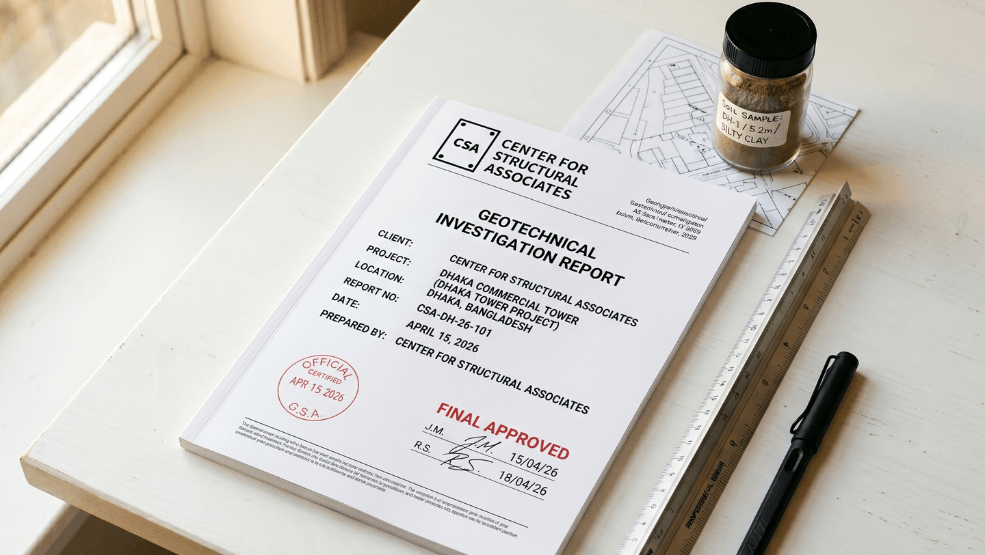
A soil test report – formally called a geotechnical investigation report – is an engineering document that describes your land’s soil properties, bearing capacity, groundwater level, and foundation recommendations for a specific plot. It tells your structural engineer whether the ground beneath your building can safely carry the loads you plan to put on it.
Under BNBC 2020 (Bangladesh National Building Code 2020), soil investigation is mandatory for all buildings with a foundation depth exceeding 3 meters. This is not optional. RAJUK will not approve a building permit without a valid geotechnical report stamped by a certified engineer. Skipping the test does not save money – it creates a structure that cannot be legally permitted, insured, or safely occupied.
What happens when building owners skip or dismiss the soil test?
Columns settle unevenly, cracking walls and beams
Basements flood because groundwater levels were never checked
Pile designs are undersized because raw (uncorrected) SPT values were used instead of corrected ones
The entire foundation must be redesigned mid-construction – at two to five times the cost of getting it right the first time
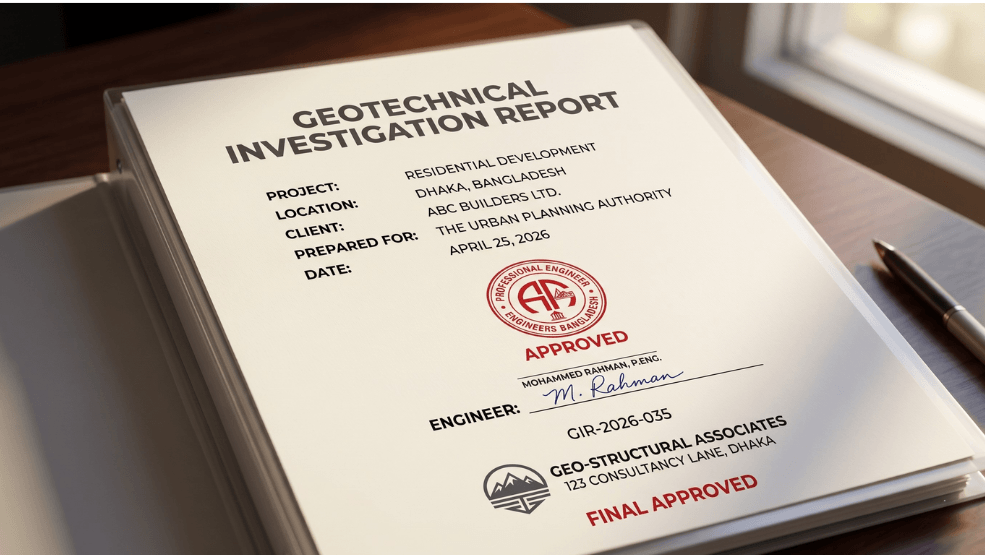
The report must be prepared by a licensed geotechnical engineering firm. The final document must carry the seal and signature of a certified engineer registered with the Bangladesh Engineering Council. A report without a certification seal is not legally valid under BNBC 2020.
Always verify the firm’s credentials before commissioning a soil test. Ask for their BEC registration number. If they cannot provide it, find another firm.
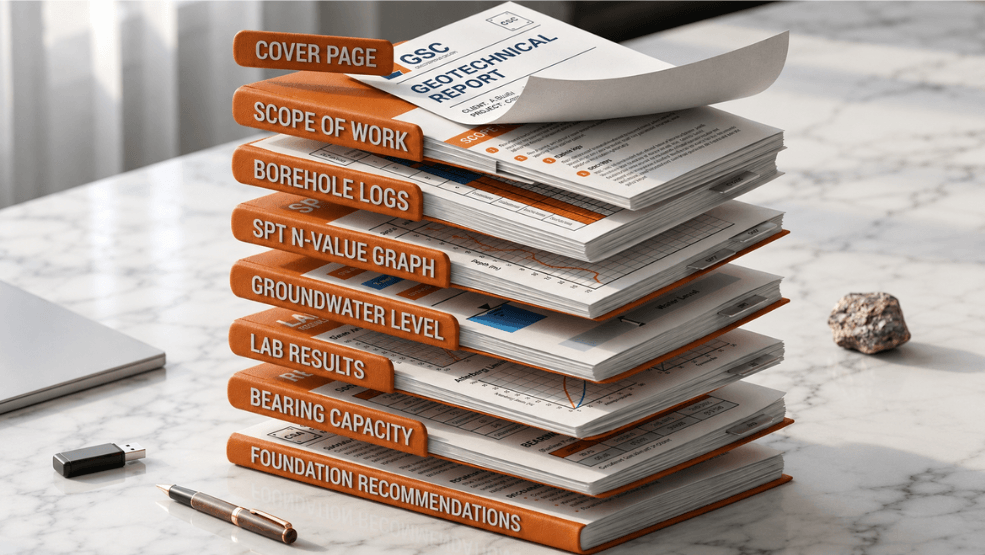
The 8 Sections of a Standard Bangladesh Soil Test Report (And What Each One Means)
A proper soil test report in Bangladesh follows a standard structure. Here is each section decoded – what it contains, what to check, and what a red flag looks like.
1. Cover Page and Project Information
The cover page is the first quality check. Verify that the following details are accurate before reading anything else:
Site address and plot number – must match your actual land title documents
Number and location of boreholes – shows how many test points were drilled across your plot
Date of investigation – reports older than 2 years should be recommissioned
Engineering firm name, registration number, and official seal
Red flag: No certification seal on the cover page means the report is not legally valid under BNBC 2020. Do not proceed to foundation design with an unsealed report.
2. Scope of Work and Field Investigation Details
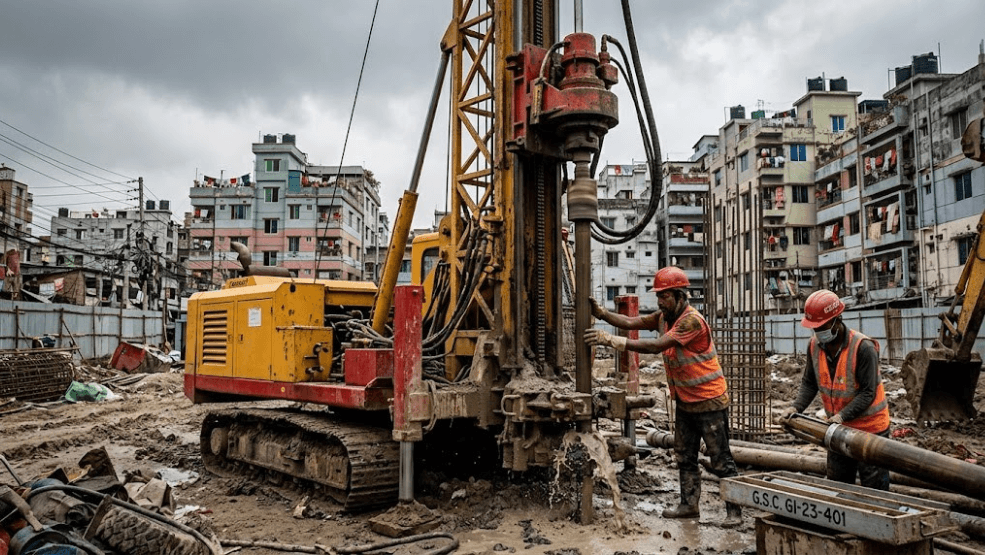
This section lists every test performed during the investigation: how many boreholes were drilled, what depth they reached, how many soil samples were collected, and which lab tests were run.
The critical check here is borehole count. Under BNBC 2020 guidelines, the minimum number of boreholes required is:
Location
Minimum Boreholes
Dhaka city
3 boreholes
Greater Dhaka / Peri-urban areas
5 boreholes
Remote districts
10 test points recommended
Borehole depth rule: Drilling must extend at least 6 meters below the proposed foundation level, OR continue until the SPT-N value exceeds 50 for three consecutive layers – whichever comes later. A borehole that stops at 20 feet for a 10-storey building is not compliant.
3. Borehole Logs – The Most Technical Section
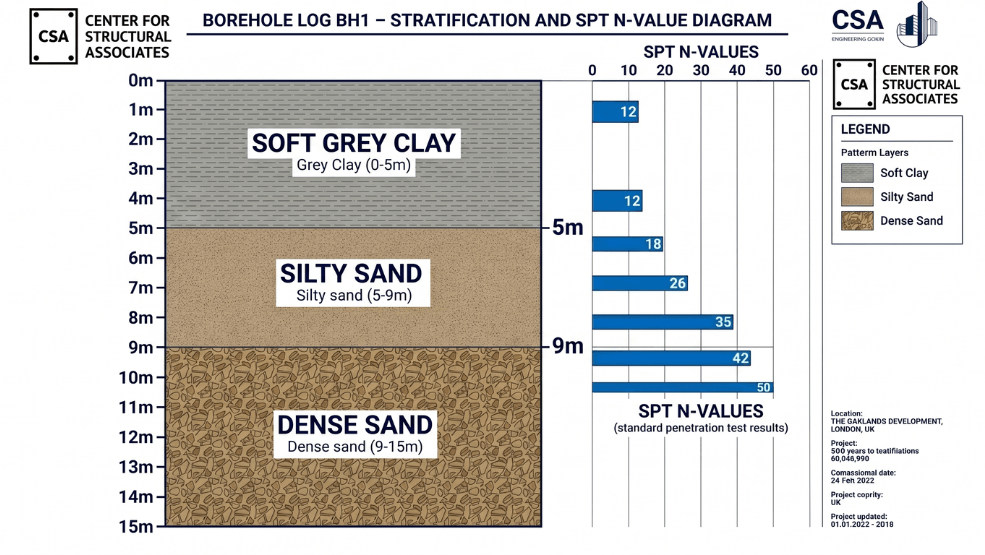
Borehole logs are vertical cross-section diagrams showing the exact soil layers found at your plot, recorded at every 1.5-meter depth interval. Each layer is coded by soil type – clay, silt, fine sand, medium sand, or gravel – and given a color or symbol key.
How to read a borehole log:
Left column: Depth in meters
Middle column: Soil type symbols and descriptions (e.g., “Soft Grey Silty Clay,” “Medium Dense Fine Sand”)
Right column: SPT N-values at each tested interval (more on this in Section 4)
Bangladesh context: Dhaka’s alluvial plains typically show soft to very soft silty clay in the top 3 to 6 meters. This is normal – but it directly triggers the need for deep foundations in most Dhaka projects. In coastal districts like Khulna, Barishal, and Noakhali, soft clay layers can extend to 10 meters or deeper.
What you want to see: Consistent layering across all boreholes with no sudden weak pockets between load-bearing layers. If borehole BH-1 shows firm sand at 8 meters but BH-3 shows soft clay at the same depth, your plot has variable soil conditions that require a more conservative – and more expensive – foundation approach.
4. SPT N-Value Graph – The Number That Decides Your Foundation
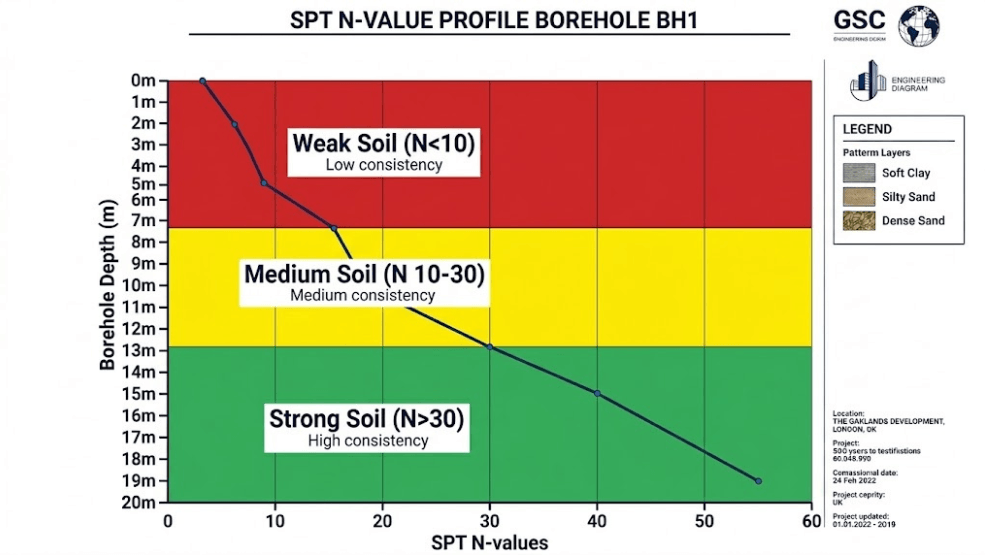
The Standard Penetration Test (SPT) is the backbone of every soil investigation in Bangladesh. A 63.5 kg hammer is dropped from a height of 76 cm to drive a sampler 45 cm into the soil. The number of hammer blows required to drive the sampler the final 30 cm is recorded as the N-value.
The higher the N-value, the stronger and denser the soil.
SPT N-Value
Soil Consistency
Foundation Implication for Bangladesh
0 – 4
Very Soft / Very Loose
Pile foundation almost certain
5 – 10
Soft / Loose
Deep foundation very likely needed
11 – 30
Medium Dense
Assess case by case with bearing capacity calculation
31 – 50
Stiff / Dense
Raft or deep isolated footing possible
> 50
Very Dense / Hard Rock
Shallow foundation may be viable
Critical detail most building owners miss: The N-values shown in your report should be corrected values – adjusted for overburden pressure at depth (expressed as N₆₀ or N₁₆₀). Many low-cost geotechnical firms in Bangladesh present raw field N-values without applying correction factors. Raw values can overstate soil strength by 20 to 40%, leading to an undersized foundation design.
Ask your geotechnical engineer directly: “Are these corrected N-values or raw field values?” The answer should be immediate. If they hesitate, the report requires review before it is used for design.
5. Groundwater Level – The Silent Foundation Enemy
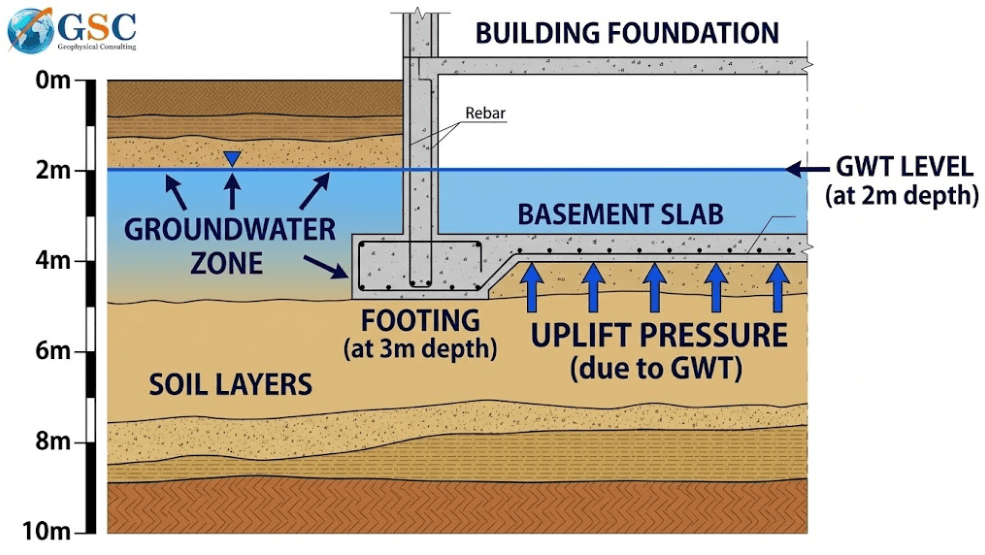
The Groundwater Level (GWL) recorded in your report tells you the exact depth at which free water sits below your plot at the time of investigation. This single data point controls whether your basement is viable, whether dewatering is needed during construction, and whether uplift pressure will push your ground slab upward.
Bangladesh reality: Bangladesh has one of the highest groundwater table concentrations in South Asia. In Dhaka, Sylhet, Khulna, and all coastal districts, the GWL is commonly found at 1.5 to 3 meters below ground level – and rises further during monsoon season (June to September).
Two scenarios and what they mean:
If GWL is above your proposed foundation depth:
Basement waterproofing is mandatory – not optional
Active dewatering is required during excavation and foundation casting
Uplift pressure (buoyancy force) must be calculated and countered in the slab design
Construction cost increases significantly
If GWL is below your proposed foundation depth:
Standard footing design applies
Routine waterproofing precautions are still advisable in Bangladesh’s climate
6. Laboratory Test Results
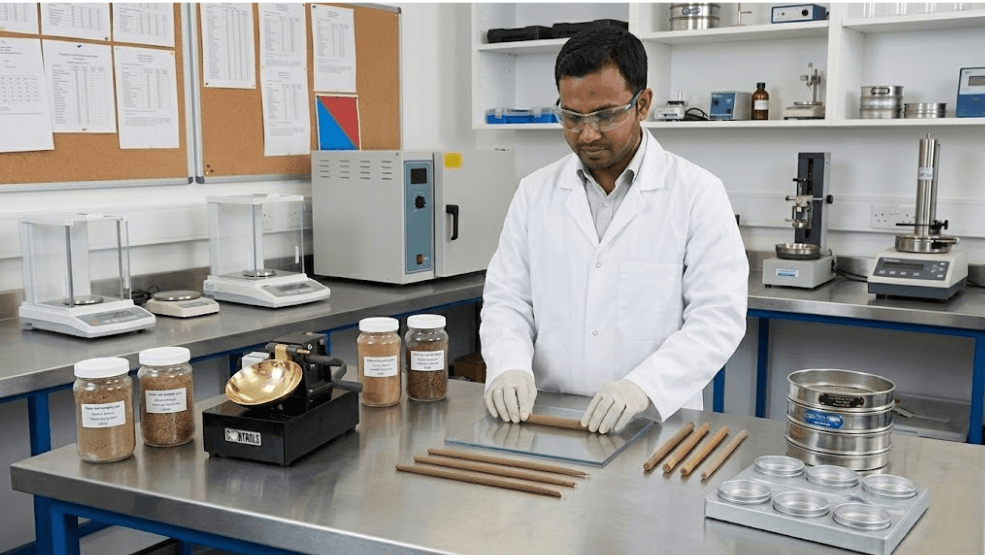
After field drilling, collected soil samples are sent to an accredited geotechnical laboratory – ideally certified by BUET’s BRTC (Building Research, Training and Consultation) – for detailed analysis. These tests quantify the physical and mechanical properties of your soil.
Laboratory Test
What It Measures
Why It Matters for Your Foundation
Atterberg Limits
Liquid and plastic limits of clay
Identifies swelling, shrinkage, and long-term settlement risk
Natural Moisture Content
Water already present in soil
High moisture = high compressibility = more settlement
Particle Size Distribution
Percentage of sand, silt, and clay
Determines drainage behavior and load transfer mechanism
Unconfined Compression Test
Shear strength of cohesive soil
Defines how much load clay layers can safely carry
Specific Gravity
Density of soil particles
Used in bearing capacity and settlement calculations
What to look for: If Atterberg limit tests show a high Plasticity Index (PI > 20), the soil has significant clay content that will swell with water absorption and shrink during dry seasons. This behavior causes long-term differential settlement in foundations that were not designed to account for it.
7. Bearing Capacity Calculations
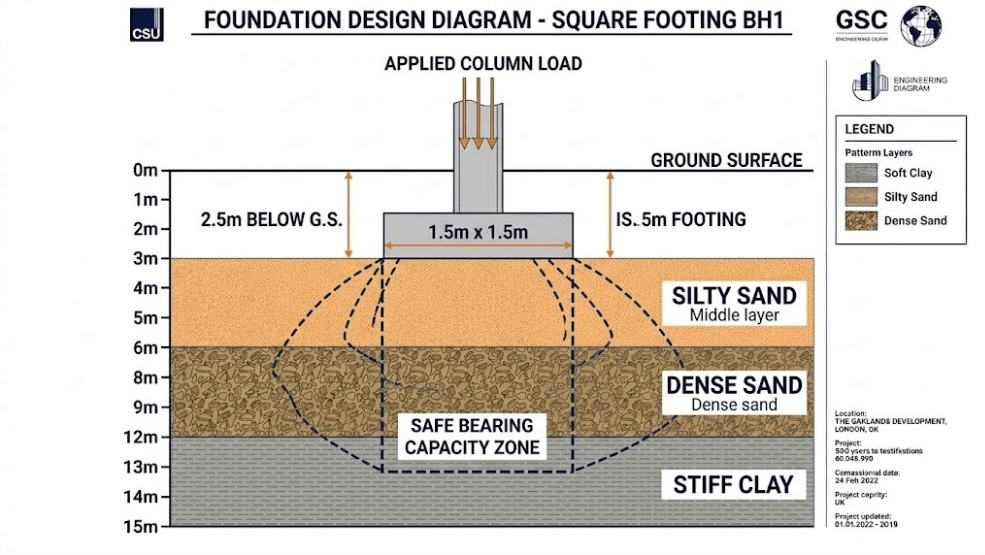
Safe Bearing Capacity (SBC) is the maximum load per unit area that your soil can support without shear failure or excessive settlement. It is the number your structural engineer uses to calculate the minimum size of every footing in your building.
Typical Safe Bearing Capacity ranges in Bangladesh:
Soil Condition
Typical SBC Range
Soft Dhaka alluvial clay (top 5m)
50 – 80 kN/m²
Medium dense silty sand
100 – 150 kN/m²
Medium dense fine sand
150 – 250 kN/m²
Dense sand or compact gravel
300+ kN/m²
How your structural engineer applies this: Each column in your building carries a calculated load (in kN). Dividing that load by the SBC gives the minimum footing area needed. A column carrying 500 kN on soil with an SBC of 100 kN/m² requires a footing of at least 5 square meters.
Settlement check: Even when the SBC is adequate, settlement must stay within allowable limits under BNBC 2020 – typically 25 mm for isolated footings and 40 mm for raft foundations. A soil with acceptable bearing capacity can still fail the settlement check if it is highly compressible.
8. Foundation Recommendations – Read This Section First
The foundation recommendations section is where the geotechnical engineer states – in direct, actionable language – exactly what type of foundation your plot requires, at what depth, and with what specifications.
A compliant recommendation section will specify:
Foundation type: Shallow (isolated footing, raft) or deep (pile)
Foundation depth: Minimum embedment depth below ground level
Allowable bearing pressure at the recommended foundation level
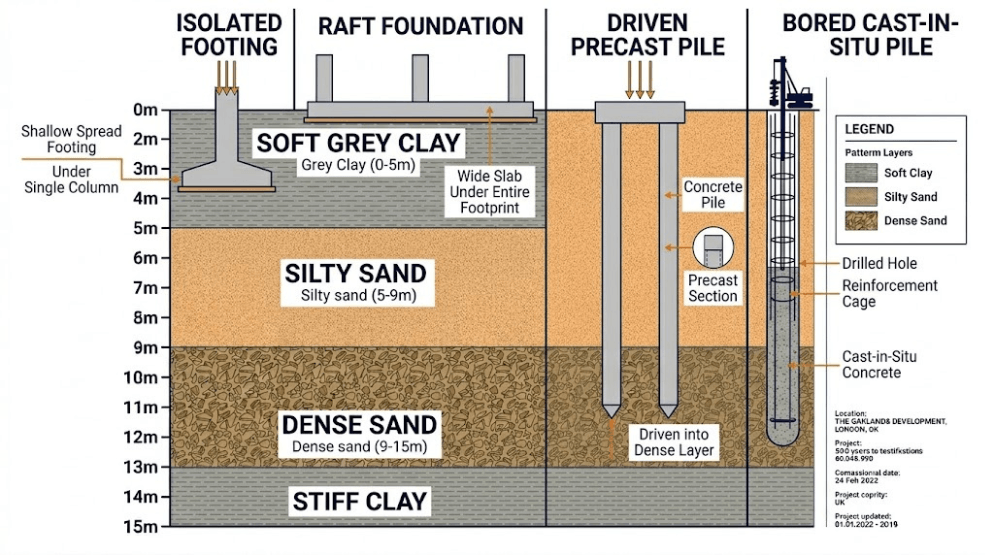
Foundation types commonly recommended in Bangladesh:
Foundation Type
When It Is Used
Isolated Footing
Firm soil at shallow depth, low-rise buildings (up to 3 storeys)
Raft Foundation
Weak or variable soil, even load distribution needed, basements
Driven Precast Concrete Pile
Most common in Dhaka for 4+ storey buildings on soft alluvial soil
Bored Cast-In-Situ Pile
High-rise structures, very heavy loads, deep firm layer needed
Never override the foundation recommendation without commissioning a second independent geotechnical opinion. Structural engineers redesign the foundation system – they do not override the geotechnical engineer’s ground assessment.
5 Red Flags in a Soil Test Report That Should Stop Your Construction Immediately
These warning signs mean your structural engineer needs to redesign – or your geotechnical firm needs to redo the investigation – before a single brick is laid.
1. SPT-N values below 5 in the top 10 meters with no firm layer identified This means the soil has no viable load-bearing stratum within the standard foundation range. The geotechnical report must identify the depth of a firm layer capable of supporting pile tip loads. If it does not, the investigation was incomplete.
2. Groundwater table higher than the proposed foundation depth with no dewatering or waterproofing plan The report must address how construction will proceed with a high water table. Absence of dewatering recommendations in a high-GWL report is a serious professional oversight.
3. Organic content detected in soil layers Peat, decomposed vegetation, or high organic matter in soil layers causes long-term, uncontrolled consolidation settlement. There is no shallow foundation solution for organic-rich soil – only deep pile foundations bypass this problem.
4. Inconsistent layering between boreholes If BH-1, BH-2, and BH-3 show dramatically different soil profiles at the same depths, the plot may contain an old pond, filled land, or underground drainage channels. This requires additional investigation before design proceeds.
5. Report has no BNBC 2020 reference and no certified engineer’s seal Without explicit BNBC 2020 compliance references and a certified engineer’s stamp, the report does not meet RAJUK’s submission standards and will delay or block your building permit.
CSA Expert Insight
“In our experience reviewing soil reports across Dhaka, Chittagong, and Sylhet, the single most common mistake building owners make is trusting the contractor’s ‘recommended’ geotechnical firm. Many low-cost reports in Bangladesh skip corrected SPT-N values and present raw field counts – which can overstate soil strength by 20 to 40%. Always ask your geotechnical firm directly: ‘Are these corrected N-values or raw field values?’ If they cannot answer immediately, commission the report from a different firm before your structural engineer starts foundation design.”
– Ahsan Habib, Principal Structural Engineer and Founder, Center for Structural Associates (CSA)
[IMAGE PROMPT – Expert Quote / CSA Branding] A professional quote card design. Dark navy background (#151515). A Bangladeshi structural engineer (male, 40s, professional, wearing a formal shirt) shown as a small portrait photo on the left side. A quote text block on the right (placeholder text area). Bottom left shows a subtle “CSA” logo placeholder. Clean, corporate, authoritative design. 16:9 ratio.
Soil Test Cost in Bangladesh – What You Should Expect to Pay in 2026
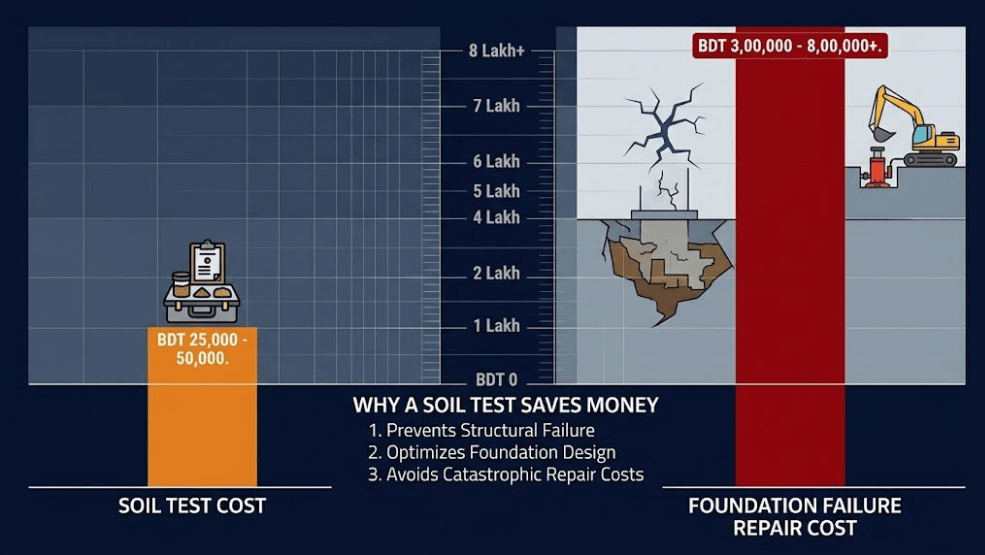
Soil test cost in Bangladesh ranges from BDT 25,000 to BDT 1,50,000 or more, depending on the number of boreholes required, borehole depth, and the project location.
Project Type
Boreholes Needed
Estimated Cost (BDT)
3-4 storey residential (Dhaka)
3
25,000 – 35,000
6-8 storey commercial (Dhaka)
4-5
50,000 – 80,000
High-rise building (10+ floors)
6+
1,00,000 – 1,50,000+
Industrial / Factory building
8-10
1,20,000 – 2,00,000+
Per-borehole cost breakdown:
Up to 60 feet (18 meters) depth: BDT 7,000 per borehole
Up to 100 feet (30 meters) depth: BDT 10,000+ per borehole
For context, a proper soil test for a 6-storey Dhaka apartment building costs approximately BDT 50,000. A single cracked column repair on a poorly founded building in Dhaka costs BDT 3 to 8 lakh. The soil test is not an expense – it is the cheapest insurance your project will ever buy.
Frequently Asked Questions About Soil Test Reports in Bangladesh
Q: Is a soil test legally required in Bangladesh?
Yes. BNBC 2020 mandates a geotechnical soil investigation for any building with a foundation depth exceeding 3 meters. RAJUK will not process a building permit application without a valid, certified soil test report. Operating without one also voids most commercial insurance policies on the structure.
Q: How many boreholes do I need for my building plot in Bangladesh?
A minimum of 3 boreholes is required for any plot, regardless of size, under BNBC 2020 guidelines. For larger plots and taller buildings, your geotechnical engineer determines the final number based on plot area, soil variability, and structural load requirements.
Q: Can I use the previous owner’s soil test report for my new construction?
This is not recommended. Soil conditions change due to nearby excavation work, seasonal groundwater fluctuations, vibration from adjacent construction, and land-filling activity. Any report older than 2 years should be treated as reference material only – not as a design basis. Commission a fresh investigation for any new structure.
Q: What is a good SPT N-value for a building foundation in Bangladesh?
For shallow foundations (isolated footings or raft), N-values above 30 in the founding soil layer are considered reliable. Values below 10 in the top 10 meters almost always indicate that pile foundations are required. The specific threshold depends on the building’s load, the foundation type, and settlement limits – always defer to your structural engineer’s interpretation.
Q: How deep should a borehole be for a 6-storey building in Bangladesh?
For a 6-storey building on Dhaka’s typical alluvial soil, borehole depth should be a minimum of 20 to 25 meters (65 to 82 feet), or until the drill achieves SPT-N values consistently above 50 for three successive 1.5-meter intervals. Anything shallower risks missing a weak subsurface layer that could cause pile settlement or punching failure.
Q: Can I skip the soil test for a small 2-storey building in Bangladesh?
Under BNBC 2020, soil testing is mandatory when foundation depth exceeds 3 meters. However, even for smaller structures in Dhaka’s soft alluvial soil, skipping the test is a structural risk that no responsible engineer will endorse. Low-rise buildings have failed in Bangladesh due to undetected soft clay pockets and high water tables that a basic SPT borehole would have identified for under BDT 25,000.
Read Your Soil Report Before Your Contractor Does
A soil test report is not paperwork. It is the engineering evidence that determines whether your building stands safely for 50 years or develops structural problems within 5. Every number in that report – the SPT N-value, the groundwater level, the safe bearing capacity – translates directly into the size, depth, and cost of your foundation.
Before handing any report to a contractor, take three steps:
Check SPT values and groundwater level – these two numbers drive the foundation type decision
Read the foundation recommendations section – this is what your structural engineer must follow
Not sure what your soil test report is telling you? CSA’s structural engineering team reviews geotechnical reports across Bangladesh and translates the findings into safe, cost-effective foundation designs. Contact CSA today to book a technical consultation with a certified structural engineer before your project breaks ground.
[IMAGE PROMPT – CTA / Closing Banner] A wide professional CTA banner image. Dark background (#151515). Left side shows a Bangladeshi structural engineer in a hard hat at a construction site, reviewing blueprints. Right side has an orange accent panel (#f47621) with placeholder space for a headline and button. Clean, corporate, action-oriented design. Conveys trust and expertise. 16:9 ratio.